For months, the conversation around AI and early-career work has been loud and bleak. Headlines warn that AI is taking entry-level jobs, that young professionals are becoming unhireable, and that universities are failing to keep up.
But most of that analysis is built on forecasts and speculation, not what’s actually happening right now.
That gap is what sparked the Future-Ready Talent Series, a three-part research initiative from Virtual Internships exploring how AI is already reshaping internships, hiring, and early-career readiness across universities and employers.
Rather than asking what might happen, we asked a simpler question:
How is AI actually showing up inside internships today?
Why We Started With Internships
Internships sit at the earliest point of the talent pipeline. They’re where students first apply theory in a real workplace, where employers test potential, and where habits around productivity, judgment, and collaboration are formed.
If AI is changing how work gets done, it should show up here first.
So we focused our research at the internship level.
We surveyed interns and supervisors who had completed an internship within the past six months, alongside in-depth interviews across industries and regions, from tech startups in North America to consulting firms in Asia and Europe.
In total, the research draws on nearly 100 survey responses and 15 structured interviews.
What emerged wasn’t a story of replacement or collapse. It was something more nuanced and far more actionable.
The findings were substantial enough to span three connected reports, each revealing a different pressure point in early-career work.
In the short video below, we share what interns and employers told us directly:
how AI is showing up inside internship work today, why outcomes are diverging, and how those insights shaped the Future-Ready Talent Series.
Part One: AI in Internships and the First Test of Tomorrow’s Workforce
.png?width=261&height=261&name=unnamed%20(2).png) The first paper in the series, AI in Internships: The First Test of Tomorrow’s Workforce, is the most detailed and analytical. It lays the foundation for everything that follows and surfaces three critical themes shaping early-career work right now.
The first paper in the series, AI in Internships: The First Test of Tomorrow’s Workforce, is the most detailed and analytical. It lays the foundation for everything that follows and surfaces three critical themes shaping early-career work right now.
1. The Tale of Two Interns
Across interviews, employers independently described the same pattern. Two interns. Same tools. Same access to AI.
One intern used AI to get unstuck, move faster, and ask better questions. They didn’t take outputs at face value. They applied judgment, checked assumptions, and edited critically. AI amplified their performance, taking them from good to great.
The other intern relied on AI without context or critical thinking. Their work stayed flat or slipped. In some cases, employers began asking a difficult question: if the value added is minimal, why hire an intern at all when AI can already do that part?
AI doesn’t replace interns evenly. It amplifies capability, for better or worse.
2. The Shadow Workflow
While AI use inside internships is widespread, visibility into that use is not.
Interns reported using AI habitually across tasks like research, drafting, and even customer communication. Employers consistently underestimated that usage. Managers often saw the final deliverable, but not the reasoning, iterations, or errors corrected along the way.
This Shadow Workflow makes it harder to evaluate learning, coach effectively, or understand where support is needed. It also obscures how AI is truly shaping productivity and judgment at the earliest career stages.
3. Guidance Is Missing Where It Matters Most
Perhaps the most actionable finding: 44% of interns reported receiving no AI onboarding or guidance at all.
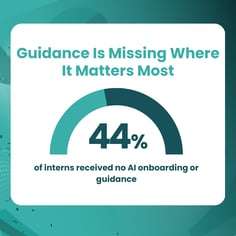
No shared expectations. No clarity around privacy or data use. No conversation about what responsible or effective AI use looks like at work. AI is present. Expectations are not.
Part Two: When AI Makes Hiring Harder, Not Easier
.png?width=233&height=233&name=unnamed%20(2).png) Despite the risks, interns were overwhelmingly optimistic.
Despite the risks, interns were overwhelmingly optimistic.
When asked how AI would impact their ability to secure internships or jobs in the next year, nearly two-thirds said it would make things easier. Preparation felt faster. Access to tools felt empowering.
But even as interns used AI to accelerate their work, the hiring process was shifting beneath them.
Employers told a different story. They described an influx of ATS-perfect resumes, AI-assisted interviews, and polished applications that were harder to evaluate. Hiring wasn’t slowing because of AI. It was getting noisier.
That disconnect became the focus of Beyond the AI-Perfect Resume: Decoding the New Hiring Signals, which explores how companies are adapting evaluation and how real work (not surface-level polish) is becoming a more important signal.
Part Three: The Training Standoff No One Owns
The final paper asks a harder question: who is responsible for preparing early-career professionals to use AI effectively at work?
In conversation, answers sounded collaborative. In practice, responsibility was shifted.
Employers most often ranked individuals as most responsible. Interns split responsibility between universities and self-upskilling. Employers consistently ranked themselves last.
When responsibility is shared in theory but avoided in execution, training falls through the cracks.
That gap is unpacked in Closing the Readiness Void: Solving the Training Standoff, which explores how universities, employers, and intermediaries can better align to support AI readiness without overburdening any single group.
How the Series Is Designed to Be Read
All three papers work together. But Paper One is the entry point.
It is the densest, broadest exploration of the data and sets the context for everything that follows, from hiring signals to training responsibility.
If you want to understand how AI is actually reshaping internships today, start there.
Or explore the key themes in our upcoming blog series, starting with The Tale of Two Interns.
Because the future of early-career work is already unfolding, and it’s far more nuanced than the headlines suggest.