Companies
Behind the VI50: Voices and Lessons from Mentorship in Action
Explore the VI50 Report and see how mentorship turns internships into lasting impact for learners and organizations.
Across sectors, teams increasingly recognise that early-career success isn’t determined by how well interns execute individual tasks; it’s determined by the conditions in which they learn to think, collaborate, and contribute.
That’s why mentorship has become central to the way modern organisations develop talent.
And in our recent webinar, two companies, Twigs Naturals and Infonancial Solutions, offered a clear, practical look at how mentorship shapes this development from both sides: CEOs guiding the process, and former interns who are now full-time employees reflecting on how they grew.
What emerged was a set of shared principles that define what effective mentorship actually looks like inside high-functioning teams.
Before any frameworks or processes come into play, effective mentorship begins with how mentors view the people they support.
For Nigel Jordan, CEO of Twigs Naturals, this began with a principle shaped early in his own career:
With this mindset, interns at Twigs Naturals, including Kananelo Thoabala - now a full-time Accounting Assistant, were welcomed not as temporary helpers, but as contributors with something meaningful to offer.
This shift changed how Kananelo approached her role:
Her reflection highlights a core truth:
confidence accelerates when interns feel their work has purpose and context.
Both organisations highlighted that mentorship only creates consistent outcomes when it is supported by intentional structure.
At Twigs Naturals, this meant developing a clear people and culture framework, defined checkpoints, and transparent expectations around growth.
At Infonancial Solutions, CEO Tucker Sholtes described structure as the foundation that helps interns understand the company before they take on heavier responsibilities:
For Nabeel Alabed, now a Technical Product Manager, this structure transformed moments of uncertainty into learning opportunities that built his capability over time.
Perhaps the most revealing insight from the webinar was the role that challenge, not comfort, plays in growth.
Tucker explained why stepping in too quickly can limit development: “If they raise their hand too soon, their thinking stops.”
Instead of giving answers, mentors guided interns through the process of exploring, questioning, and refining their reasoning. This approach built resilience, problem-solving ability, and stronger judgment, qualities now essential in a landscape shaped by rapid technological change.
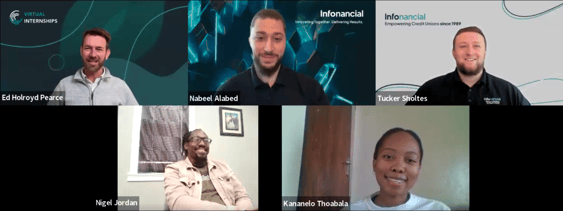
A snapshot of our panelists during the webinar
As Nabeel reflected, the turning point wasn’t mastery of a tool or task, it was learning how to think through obstacles with support, not substitution.
The conversation also highlighted how mentorship builds adaptability, a skill now central to employability. Interns described how guidance helped them not only use new tools but also interpret them and make sense of shifting expectations in their roles.
This kind of adaptability cannot be taught purely through training modules. It develops when learners are supported through real-world complexity, with mentors helping them identify patterns, make informed decisions, and reflect on outcomes.
Mentorship fosters the habits of mind that enable early-career talent to continue learning long after the internship concludes.
While this blog highlights the key insights, the full webinar brings forward the nuance, the tone of the conversations, the lived experiences of mentors and interns, and the real developmental moments that shaped their journeys.
→ Dive deeper into the mentorship practices shared
If you’re interested in shaping internship programs or learner experiences with this level of structure and mentorship, we’d be glad to explore how Virtual Internships can support your goals.
Expand access to high-quality, industry-aligned work experiences for your learners.
Build a scalable, supported internship experience that strengthens your talent pipeline.
Explore the VI50 Report and see how mentorship turns internships into lasting impact for learners and organizations.
How structured mentorship within internships turns early-career talent into confident hires, with real examples from the VI50 webinar.
See how 50 companies worldwide are setting new standards in internships. Explore insights, data, and a blueprint for mentorship-driven success.